Industries

Products & Services
Why palmiq?
Partners
Resources
The evolution from single-cloud to multicloud architectures represents more than just a technology trend, it's a fundamental shift in how organizations approach business resilience. As enterprises across the Americas migrate critical workloads to cloud environments, the question is no longer whether to adopt cloud infrastructure, but how to design cloud deployments that genuinely enhance rather than complicate business continuity.
At palmiq, our experience implementing cloud solutions for government agencies, pharmaceutical companies, and commercial enterprises throughout the region has revealed a critical insight: multicloud strategies done right dramatically improve organizational resilience, while multicloud done poorly creates fragmentation, complexity, and new failure points that undermine the very resilience organizations sought to achieve.
The difference comes down to intentional architecture versus accidental accumulation. Organizations that strategically design multicloud environments with resilience as a primary objective, leveraging platforms like Acronis that provide unified management across diverse cloud providers, achieve remarkable improvements in availability, disaster recovery capabilities, and operational flexibility. Those that simply accumulate cloud services reactively as different departments make independent purchasing decisions often find themselves with expensive, fragmented infrastructure that's harder to protect and recover than the on-premises systems it replaced. Understanding this distinction is essential for any organization evaluating how cloud architecture impacts their ability to withstand disruptions and maintain business operations through adverse conditions.
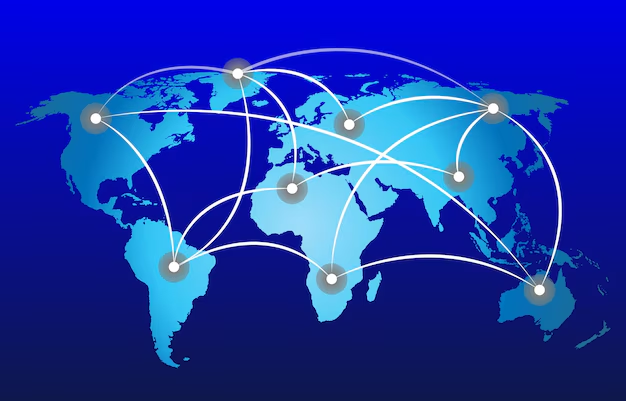
The theoretical resilience advantages of multicloud are compelling and well-documented. By distributing workloads across multiple cloud providers, AWS, Azure, Google Cloud, or regional providers serving specific markets, organizations theoretically eliminate single points of failure inherent in single-provider architectures. If one provider experiences outages, workloads fail over to alternatives. If one provider's pricing becomes unfavorable, workloads migrate to more cost-effective options. If regulatory requirements limit certain providers in specific jurisdictions, alternatives remain available.
For palmiq's clients operating across multiple countries in Latin America, this geographic and regulatory flexibility proves particularly valuable. A pharmaceutical company conducting clinical trials across Brazil, Mexico, and Colombia faces different data sovereignty requirements in each jurisdiction. Multicloud architecture allows them to place workloads in compliant locations while maintaining unified management and consistent security policies through Acronis' platform.
The resilience benefits extend beyond disaster recovery to operational flexibility. Organizations can leverage best-of-breed services from different providers rather than compromising on single-provider solutions. They can optimize costs by running workloads where pricing is most favorable. They avoid vendor lock-in that limits negotiating leverage and future flexibility. These advantages are real, but they don't materialize automatically. The gap between multicloud's theoretical promise and practical reality depends entirely on implementation approach.
The primary challenge multicloud introduces is complexity, and complexity is resilience's enemy. Each additional cloud provider multiplies the management surface area: different APIs, distinct security models, unique networking paradigms, separate identity systems, varying monitoring tools, and divergent backup methodologies.
Without unified management capabilities, organizations quickly find themselves managing not one infrastructure but several parallel infrastructures that happen to support the same business. This fragmentation undermines resilience in multiple ways. Incident response becomes complicated when teams must navigate different provider consoles during outages. Security policies diverge across environments, creating gaps that attackers exploit. Backup strategies fragment, leaving some workloads well-protected while others remain vulnerable.
palmiq addresses this complexity through Acronis' unified cyber protection platform that spans multicloud environments. Rather than managing separate backup solutions for AWS, Azure, and on-premises infrastructure, clients gain single-pane visibility and consistent protection policies regardless of where workloads reside. This unified approach converts multicloud complexity from resilience liability into strategic advantage. The key insight is that multicloud resilience requires abstraction layers that hide provider-specific complexity from operational teams. When disaster strikes, responders shouldn't need specialized knowledge of three different cloud providers' recovery procedures, they need consistent, well-rehearsed processes that work uniformly across the entire infrastructure.
For organizations operating internationally, particularly common among palmiq's clientele across the Americas, multicloud architecture provides critical capabilities for managing data sovereignty and regulatory compliance requirements that directly impact business resilience. Consider a financial services firm serving customers in the United States, Mexico, and Brazil. Each jurisdiction imposes specific requirements about where customer data can be stored and processed. Single-cloud architectures force uncomfortable choices: either limit operations to jurisdictions where the provider operates compliant data centers, or accept regulatory risk by storing data in non-compliant locations.
Multicloud eliminates this constraint. The organization can leverage AWS in regions where it offers optimal services, Azure where its presence better serves compliance requirements, and regional cloud providers where local regulations or business relationships favor them. Workloads deploy where they best serve business and compliance objectives rather than where provider availability dictates.
This flexibility directly enhances resilience by reducing regulatory risk, a form of business continuity threat that's often overlooked in technology-centric resilience discussions. A regulatory enforcement action that prohibits certain data processing activities can be as disruptive as a technical outage. Multicloud architecture, properly implemented with Acronis providing consistent data protection across environments, allows organizations to adapt quickly to changing regulatory landscapes without wholesale infrastructure redesigns. The pharmaceutical clients palmiq serves particularly benefit from this flexibility. Clinical trial data, manufacturing records, and regulatory submissions face stringent requirements that vary by jurisdiction. Multicloud architecture allows these organizations to maintain compliance while ensuring data protection and business continuity across their global operations.

.png)

Geographic distribution represents one of multicloud's most straightforward resilience advantages. Traditional disaster recovery relied on maintaining secondary data centers in different geographic regions, expensive propositions that smaller organizations often couldn't justify. Cloud providers offer global infrastructure, but depending on a single provider still creates concentration risk.
Multicloud allows organizations to implement geographic redundancy across truly independent infrastructure. Production workloads run on one provider in a primary region, while disaster recovery capacity exists on a different provider in a geographically distant location. This eliminates scenarios where provider-wide outages, which, though rare, do occur, take down both production and DR environments simultaneously.
palmiq implements these architectures regularly, leveraging Acronis' replication and orchestration capabilities to maintain synchronized workloads across disparate cloud providers. For a logistics company whose operations depend on real-time tracking and route optimization, we've architected primary operations on AWS in North America with failover capability to Azure in South America. The geographic and provider diversity ensures that regional events, provider-specific outages, or even major disaster scenarios don't eliminate operational capability. The implementation complexity shouldn't be underestimated. Maintaining synchronized data across providers, orchestrating failover procedures, and testing recovery capabilities require sophisticated tooling and expertise. This is where strategic IT service providers differentiate themselves, not just implementing the architecture but ensuring it actually functions as intended when disaster strikes.
Resilience encompasses more than disaster recovery, it includes the ability to maintain acceptable performance under varying conditions. Multicloud architecture enables sophisticated workload optimization strategies that improve this operational resilience dimension.
Different cloud providers excel at different workload types. AWS historically led in breadth of services and ecosystem maturity. Azure integrates tightly with Microsoft enterprise software. Google Cloud offers strength in data analytics and machine learning. Regional providers often provide better performance and lower latency for geographically concentrated user bases. Strategic multicloud architecture places workloads where they perform optimally, rather than forcing everything onto a single provider's platform. An e-commerce company might run their core transaction processing on AWS, their business intelligence workloads on Google Cloud's BigQuery, and their Microsoft 365 integration on Azure, each workload optimized for its specific requirements.
This optimization directly supports business resilience by ensuring that performance degradation in one environment doesn't cascade across the entire application stack. When properly isolated with appropriate failover capabilities, issues affecting one cloud provider or service impact only the specific workload running there, not the entire business operation. palmiq's implementation approach, supported by Acronis' unified monitoring and management, provides the visibility necessary to identify optimization opportunities and the flexibility to act on them without creating management chaos.
Financial resilience, the ability to maintain operations despite cost pressures or economic volatility, benefits significantly from multicloud's competitive dynamics. Organizations dependent on single cloud providers lack leverage when negotiating pricing or responding to cost increases. Those with proven multicloud capabilities can credibly threaten workload migration if providers become uncompetitive. This isn't theoretical. palmiq has helped clients achieve substantial cost reductions by demonstrating willingness and capability to shift workloads between providers based on pricing, support quality, or service capabilities. The mere existence of multicloud architecture creates negotiating leverage even when actual migration never occurs.
For organizations operating across the Americas, where currency fluctuations and regional economic volatility create financial uncertainty, this cost flexibility represents genuine resilience improvement. The ability to shift workloads to providers offering more favorable pricing in local currencies, or to take advantage of regional economic incentives for data center operations, provides financial cushion during economic stress.
Acronis' platform facilitates this flexibility by ensuring that regardless of where workloads operate, data protection and security remain consistent. Organizations can optimize costs without compromising the protection posture that resilience requires.
Security and resilience are inseparable, an organization that cannot protect itself from threats lacks genuine business continuity capability. Multicloud architecture presents both security challenges and opportunities that directly impact resilience. The challenge is straightforward: more environments mean larger attack surfaces and more potential misconfiguration points. Each cloud provider implements security differently, creating learning curves and opportunities for gaps in security posture. Organizations that manage multicloud environments without unified security frameworks inevitably develop inconsistencies that attackers exploit.
The opportunity lies in defense diversity. Just as monoculture crops face existential threats from diseases targeting that specific variety, single-cloud architectures face concentrated risk from provider-specific vulnerabilities or attack techniques. Multicloud diversity means that exploitation techniques effective against one provider don't necessarily compromise the entire infrastructure.
palmiq's security approach, leveraging Acronis Cyber Protect's integrated capabilities, implements consistent security policies across multicloud environments while allowing provider-specific optimizations. Advanced threat detection, behavioral analysis, and integrated backup with security features ensure that security doesn't fragment even as infrastructure diversifies. For organizations in regulated industries, healthcare, financial services, government, this consistent security posture across diverse environments proves essential for both compliance and operational resilience.
Despite multicloud's advantages, it's not universally appropriate. Organizations with straightforward requirements, limited technical teams, or highly integrated application stacks may find that multicloud complexity undermines rather than enhances resilience.
palmiq's consulting approach begins with honest assessment of whether multicloud serves genuine business requirements or represents technology complexity for its own sake. A small professional services firm with basic infrastructure needs probably achieves better resilience through simple, well-executed single-cloud architecture than through sophisticated multicloud environments they lack resources to manage properly. For organizations where multicloud makes sense, phased implementation approaches that begin with solid single-cloud foundations before expanding to multiple providers typically succeed better than ambitious big-bang multicloud deployments.
When multicloud fits organizational requirements, certain implementation principles separate resilient architectures from fragmented ones:
1. Unified management is non-negotiable. Platforms like Acronis that provide consistent visibility and control across diverse environments are essential infrastructure, not optional additions.
2. Standardization before diversification. Establish consistent security policies, backup strategies, and operational procedures within a single cloud before expanding to multiple providers.
3. Purpose-driven provider selection. Choose additional providers to solve specific problems, compliance requirements, performance optimization, cost reduction, not just to check the multicloud box.
4. Automation over manual processes. The only way to manage multicloud complexity sustainably is through extensive automation of deployment, monitoring, backup, and recovery procedures.
5. Regular testing is mandatory. Theoretical failover capabilities that haven't been tested regularly under realistic conditions aren't capabilities at all, they're wishes that fail when actually needed.
Multicloud's resilience benefits materialize most fully when organizations partner with experienced IT service providers who've navigated these complexities repeatedly across diverse client environments. palmiq's two decades serving clients throughout the Americas, combined with our strategic partnership with Acronis, provides exactly this experience base.
We've seen what works and what fails. We understand which resilience improvements justify multicloud complexity and which don't. Likewise, we know how to implement unified management that actually simplifies operations rather than adding another layer of complexity. Most importantly, we've proven these approaches through real incidents, not just theoretical architectures.
Multicloud impacts business resilience profoundly, but the impact can be positive or negative, depending entirely on implementation quality. Strategic approach, appropriate tooling, and experienced guidance convert multicloud from complexity burden into genuine competitive advantage that keeps organizations operational through whatever disruptions they face.